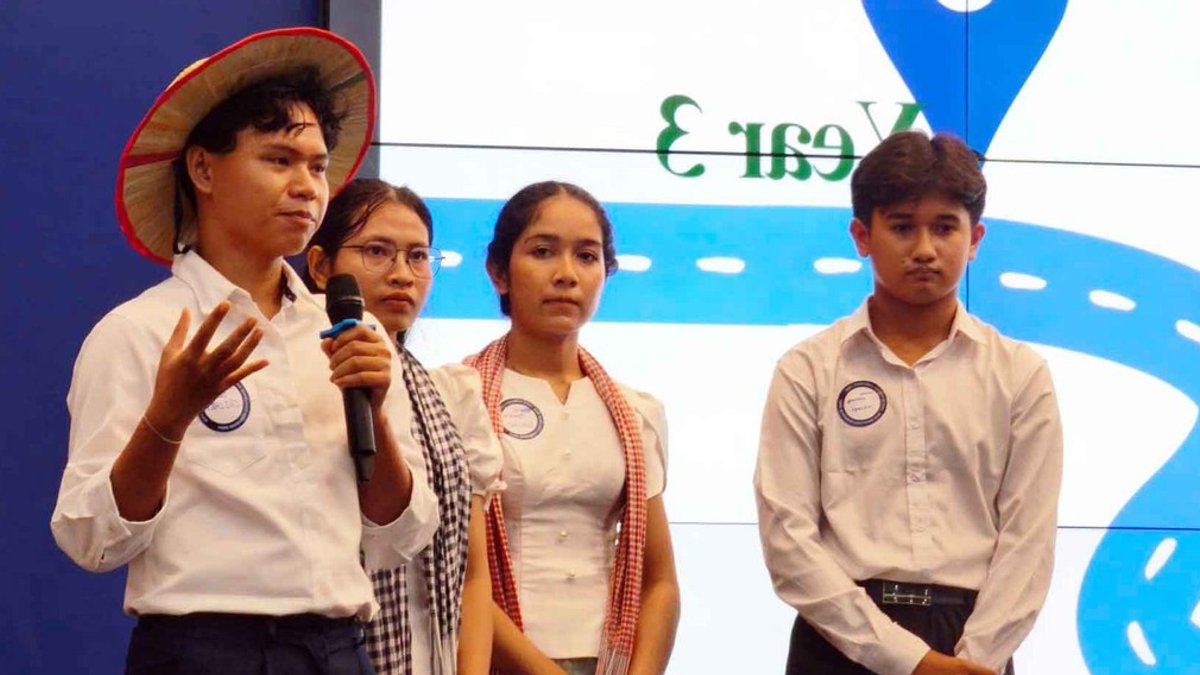
Six student teams from Vietnam, Cambodia, the Philippines, and South Africa presented agricultural and food-access innovations at the final round of the UNIIC Business Challenge 2026 in Ho Chi Minh City yesterday.
The event is organized by the University Incubation and Innovation Consortium, a network of 25 universities across 11 Asian and African countries. The initiative aims to encourage entrepreneurship and practical problem-solving among students.
Supporting small coffee farms
A team from Hung Vuong University introduced Agri-iTech, a system designed to assist Robusta coffee farmers in Dak Nong Province, a key coffee-growing region in Vietnam’s Central Highlands.
The project uses sensors to collect real-time data on soil moisture, temperature, and other environmental factors. Information is transmitted over 4G networks and analyzed by artificial intelligence to suggest irrigation schedules, fertilizer use, and yield forecasts. Farmers receive alerts directly on their phones.
Plans include creating digital profiles for each growing area, documenting coffee varieties, cultivation history, inputs, and harvest periods. Each sensor device costs around $200, with an initial investment of $19,400.
Rice husks into soil enhancer
Students from Chea Sim Kamchaymear University in Cambodia proposed a solution for rice husks, an agricultural byproduct widely generated in rice-producing countries across Southeast Asia. The team, named ChiChet, plans to heat rice husks in a low-oxygen environment to produce biochar, a carbon-rich material that can be added to soil.
Biochar improves soil’s ability to retain water and nutrients. The project targets farmers, cooperatives, and fertilizer companies in Prey Veng, Kampong Cham, and Battambang during its first two years.
Food access in small quantities
A team from the University of Mpumalanga in South Africa presented HLENGA, an automated dispenser allowing consumers to buy staple foods like rice, maize meal, beans, and cooking oil in smaller amounts instead of full packages.
Users bring their own containers to local stores hosting the machines, which hold up to 60 kilograms of goods. Store owners earn a 5-10% commission on sales.
“We want to break down purchasing power,” the team said. “Families don’t need enough money for a whole large package when they can buy only what they need.”
Related: Crypto users must provide tax ID now
Maize meal, a ground corn product, is a dietary staple in parts of southern Africa.
Competition focuses on real-world problems
The UNIIC Business Challenge prioritizes practical solutions over purely technological innovations. This year’s projects addressed agriculture, food security, and resource efficiency.
Nguyen Thi My Dung, vice president of Hung Vuong University, called the competition a testing ground for business thinking. Students develop ideas, receive feedback, and refine their projects in a collaborative setting.
Dung noted that the ability to turn ideas into value determines progress. The consortium’s network connects universities across borders, enabling shared learning.
The challenge highlights how local solutions can address global issues like food security and sustainable farming.